
“The restored third act was bold, brilliant. The fourth.. was outstanding. I saw a woman disguised in her maid’s clothes hear her husband speak the first tender words he has offered her in years, simply because he thinks she is someone else. I heard the music of true forgiveness filling the theatre, conferring on all who sat there perfect absolution. God was singing through this little man to all the world. Unstoppable. Making my defeat more bitter with every passing bar.”
– Antonio Salieri describing Mozart’s opera Nozze de Figaro in Amadeus (1984)
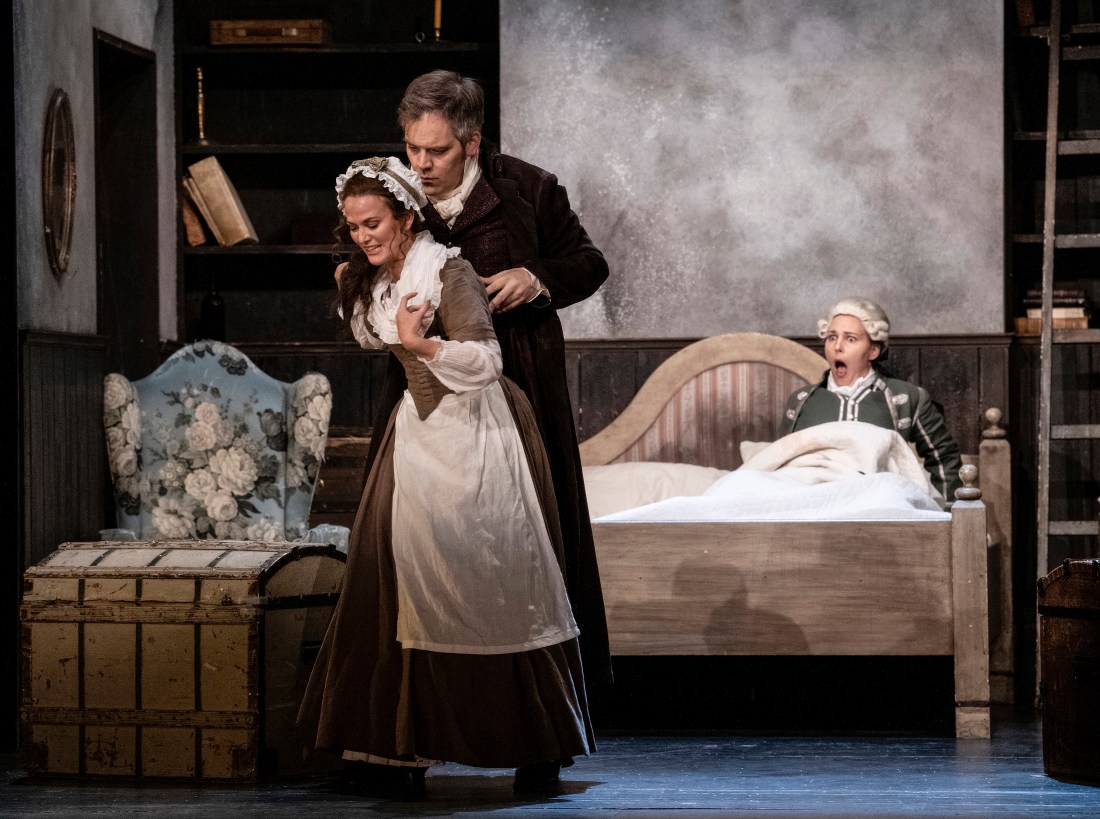
Today was my 18th birthday, and as a birthday present to myself, I booked myself a ticket to see Mozart’s opera “The marriage of Figaro” at the national opera here in Norway. I’ve been looking forward to this day for months, and even pre-bought a glass of champagne, macaroons and chocolate confections that I could pick up in the break after the second act as far back as July. The opera was all I could hope for, and more.
Of course so much credit goes to the wonderful ensemble and production team behind this wonderful performance, bringing one of Mozart’s most popular operas to life once again. However, in this post I want to discuss more so the opera itself, and not only my specific experience (although it was wonderful and absolutely worthy of discussion as well).
The Marriage or Figaro was originally a french play written by Pierre Beaumarchais, titled La Folle Journée, ou Le Mariage de Figaro (“The Mad Day, or The Marriage of Figaro”), and was the second play in the Figaro trilogy. Due to political controversy and criticism linked to the portrayal of social classes in the play, it was banned in France.
Therefore Mozart and his librettist Lorenzo Da Ponte had to make sure to create a milder operatic version of the play, which the Austrian emperor accepted, allowing the 4 act opera buffa (comedy opera) to have its premiere in Vienna in 1786. The audience was so delighted they applauded for so long that it actually called for five extra-numbers. Mozart himself conducted the first two performances of the opera, and also played the cembalo.
The opera takes place in the palace of Count Almaviva near Sevilla, Spain in the late 1700s. Here you meet many different characters, the main ones being Figaro and Susanna who are about to be married. They are the servant and maid of the Count and Countess. You also meet the hormonal teenage boy Cherubino, who is very fond of women (the countess in particular), Dr Bartolo and Marcellina (who try to get Figaro to marry her to cancel out a debt he can’t afford to pay, but whoops! Spoiler alert- the secondary plot is resolved when they discover Marcellina is actually Figaro’s mother and that he is her and Bartolo’s long lost son, resulting in a double wedding. Between Marcellina and Bartolo, and Figaro and Susanna, to make things clear. Marcellina doesn’t end up marrying her son in the end). The main plot of the play is based around the Count being unfaithful, and now trying to seduce Susanna. The countess is aware of this and is reasonably upset, and comes up with a plan with Susanna to trick the Count to catch him red-handed.
The opera ends with the Count, ashamed and remorseful, asking his wife for forgiveness. The countess responds to her cheating husband with “I am more tender-hearted, I do forgive you”. Then all who are gathered there exclaim “Thus happiness is assured. Only love can end this crazy day in happiness and joy!“
Although it was written in the late 1700s, it is still one of the most frequently played operas around the world. I believe this is because of the sincere humanity that is present in it. Here, you find raw emotions- envy, desire, love, lust, vengefulness, shame, forgiveness– all of which still apply today. It is a timeless portrayal of the human experience, the good and the bad, which we can all so painfully and pleasantly relate to. That, and the immaculate artwork which is the music, which is infinite in itself.
In conclusion, I had a wonderful time at the opera celebrating my 18th year this evening. It is a profound experience to be able to not only witness, but to be completely immersed in the music that one of the greatest composers the world has ever seen (and my very favourite) created almost 250 years ago. It is something which undoubtably made a lasting impact on my young mind. And I am certainly not alone in feeling this way. A century after the opera’s creation, Johannes Brahms said “In my opinion, each number in Figaro is a miracle. It is totally beyond me how anyone could create anything so perfect; nothing like it was ever done again, not even by Beethoven.”
I hope you enjoy this very last resistive from Mozart’s opera. I will link the scene from Amadeus with the quote I began this post with as well. 🙂
 Kovu's music